



Elected officials see angry voters cram into local meeting rooms and line streets to oppose data centers and feel an irresistible urge to cater to the populist anger. The next thing they do is hit the pause button.
However, leadership requires thinking through consequences. Moratoria on new data center construction will arrest innovation, cede the future of artificial intelligence to Beijing and threaten our national security. Blanket opposition deprives hardworking Americans of hundreds of millions of dollars in future wages per year. It shackles the most vibrant sector in commercial construction and eliminates a tax revenue lifeline that is currently funding local police departments, roads and teacher salaries in counties across the nation.
If Democrats want to regain the trust of the American people, we must have a defined vision for the future that brings prosperity to all – not just the ultrarich – and we have to be for something not just saying, “No.” We need to offer a constructive solution that doesn’t succumb to fearmongering, and prove that the party of the New Deal, the Great Society and the Apollo program is the party of solutions and sound policy, not demagoguery.
FROM NEW YORK TO TEXAS, STATES SHOULD RESPECT LOCAL CONTROL ON DATA CENTERS
Today, our party’s message is controlled by a vocal minority who don’t understand – or perhaps care – about the facts. In New York State in July, for instance, Democratic Gov. Kathy Hochul imposed a statewide moratorium on new data center construction. A growing number of local jurisdictions are taking similar action. In Congress, Independent Vermont Sen. Bernie Sanders and New York Democratic Rep. Alexandria Ocasio-Cortez are proposing a national moratorium.
Have they considered that without data centers, the internet, their path to fame and national stature, is essentially useless? The tech industry would collapse, and the economy would enter a tailspin. In lieu of letting states lead the way with blunt-force moratoria, we should develop national- or state-level Centers of Excellence that would provide every county board and municipal zoning authority the knowledge to make informed, transparent decisions. Those local governing bodies should absolutely listen to their constituents, be mindful of their many concerns, but above all, they need to give as much weight to facts as to emotions.
Consider the controversy over electricity prices. It isn’t data centers driving up residential rates but a combination of issues with our aging power grid, President Donald Trump’s pointless war in Iran, and the ongoing war in Ukraine. The data center industry has agreed to supply its own power or pay for grid upgrades. The White House’s Ratepayer Protection Pledge now has 200 signatories resolving to find policy solutions. If data center and technology companies want to pay for the grid upgrades, let them.
Multiple studies show that under a well-designed rate policy, such as the new rate for Virginia’s Dominion Energy large-load customers, data centers pay as much or more in fees than the cost of the energy they consume, precluding the need for rate hikes while providing extra funds for grid upgrades and additional generation online, including nuclear and renewables.
Americans alarmed about water used to cool servers should know data centers’ consumption is a drop in the bucket compared to residential lawn irrigation, household plumbing leaks and golf courses. Here in Virginia, a state legislative committee found “most data centers use about the same amount of water or less as an average large office building.”
Newer data centers use treated sewage or closed-loop systems, recycling water over and over again. These are all decisions that localities should mandate, without giving up the construction jobs, the permanent jobs and the local tax revenue.
Communities also worry data centers’ backup diesel generators are dirty and noisy. But these generators typically run only about 20 hours per year (or three minutes per day) for maintenance and testing. As for emissions, the proof is in the air itself. According to the EPA, the air in Northern Virginia – a data center hub – is the cleanest in decades.
In addition to facts, skeptics need to weigh the merits of prudent planning.
AMERICA’S AI BOOM IS A JOBS OPPORTUNITY, NOT AN EXCUSE FOR UNIVERSAL BASIC INCOME
Well-conceived development must limit data centers to land properly zoned for their use. Unfortunately, in Loudoun County, my home for the past 26 years, the Board of Supervisors made a poor decision to permit data centers in areas previously zoned for some office space within residential areas. The data center developers and the union labor building the data centers follow the rules, even bad ones.
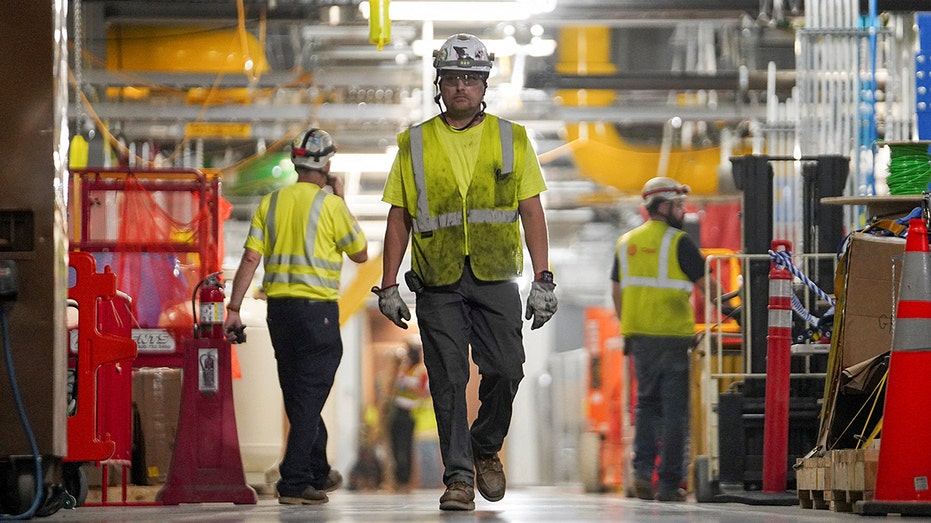
Ultimately, the debate over data centers comes down to one question: Are they net contributors to our communities? For an answer, don’t just look at the tax revenue – look at the high-paying union jobs that are creating a new middle class – employees who are able to buy a home at 28 instead of 41 – jobs that pay $45 to $60 per hour.
THE WAR ON DATA CENTERS JEOPARDIZES OUR ECONOMY AND NATIONAL SECURITY
Data centers are disproportionately high contributors but light users of public resources. A 2025 PwC study found the industry contributed $162.7 billion in federal, state, and local taxes in 2023 alone. Here in Virginia’s Loudoun County, data centers take up 2% of our land but yield 38% of tax revenue. In Mecklenburg County, local officials built the first new school in 75 years with data center proceeds.
Data centers’ role in providing jobs and funding public services put the tax incentive debate in a more realistic context than the false claim that the industry receives unmerited “handouts.”
In Virginia this year, for instance, Gov. Abigail Spanberger and Democrats in the legislature came under pressure to kill a data center tax exemption common to all industrial companies. Then, the unions came to Richmond in May to express their support for the exemption, because data center investments supported 113,000 highly skilled, well-paying jobs in Virginia alone.
Instead of a moratorium, Spanberger and the Democrats brought data center developers into the conversation and found them prepared to pay more taxes to address concerns. The legislature passed a first-in-the-nation tax on energy consumption, a step Spanberger sees as foundational to a longer-term conversation about water usage and energy standards.
CLICK HERE FOR MORE FOX NEWS OPINION
Data centers are private businesses, largely owned and operated by Americans within our framework of laws. Americans will debate; elected officials have an obligation to lead rather than simply react.
I’d urge my fellow Democrats: Follow the facts, bring data centers and their heavy spending on capital goods, wages and tax revenue into the conversation. And leave it to local authorities to decide if data centers belong in their communities.